
Runway Excursions in Aviation: A Known Risk That Still Leads to Accidents
Runway excursions remain one of the most persistent operational risks in global aviation, despite years of regulatory focus, safety data collection and preventive guidance from ICAO, IATA and EASA.
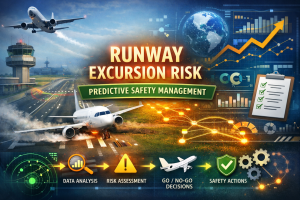
Why Runway Excursions Remain One of Aviation’s Top Safety Risks
Runway excursions continue to appear among the most frequent and high-risk accident categories in commercial aviation. The issue is not a lack of awareness. The issue is the continuing gap between known risk and operational execution.
Typical Contributing Factors
- Unstable approaches
- Wet or contaminated runway conditions
- Inadequate go-around decision-making
- Performance calculation errors
- Operational pressure and time constraints
From Data Collection to Operational Decision-Making
Modern aviation organizations are not short on data. Flight Data Monitoring, Safety Management Systems and occurrence reporting frameworks generate significant safety information. The problem is that this information is not always translated into real-time operational decisions.
- SPIs are defined but not operationalized
- Data is analyzed retrospectively rather than proactively
- SMS is weakly integrated with flight operations
- Risk assessment is not always linked to dispatch decisions
ICAO Annex 19 and the Shift to Predictive Safety
The latest Annex 19 updates reinforce a move away from reactive investigation and compliance-only thinking. The direction is clear: aviation safety must become predictive, intelligence-based and operationally integrated.
From reactive investigation and documentation-driven systems to predictive risk management, safety intelligence and integrated Safety Data Collection and Processing Systems (SDCPS)
Operational Gaps Behind Runway Excursions
Runway excursions are often the result of systemic gaps rather than isolated pilot or system errors. Many events reflect recurring weaknesses in decision-making, monitoring and organizational discipline.
- Ineffective enforcement of stabilized approach criteria
- Tolerance of operational deviations under pressure
- Weak integration of weather and runway data into live risk models
- Insufficient use of FDM / FOQA for predictive analysis
- Safety culture weaknesses under operational constraints
Regulatory Perspective: IOSA, EASA TCO and UK CAA TCO
Regulatory frameworks already address many of the known runway safety risks:
- IOSA emphasizes operational discipline, standardized procedures and effective SMS implementation
- EASA TCO focuses on operational control, oversight quality and actual implementation
- UK CAA TCO increasingly requires mature dual-compliance strategies and stronger evidence of effectiveness
These frameworks are increasingly aligned with performance-based oversight, where effectiveness matters more than documentation alone.
How to Prevent Runway Excursions: Practical Actions
- Enforce strict stabilized approach policies with zero tolerance
- Link SPIs directly to go / no-go operational decisions
- Integrate weather and runway condition data into real-time risk models
- Use FDM / FOQA data for predictive trend identification
- Strengthen communication between dispatch, crew and safety departments
- Embed safety into real operational decision-making processes
Moving from Compliance to Safety Intelligence
The aviation industry is entering a new phase. Having an SMS is no longer sufficient. Organizations must ensure their safety systems are data-driven, operationally integrated and predictive rather than reactive. This evolution marks the transition from compliance-based safety to true safety intelligence.
How Aero Support Group Supports Aviation Organizations
Aero Support Group supports operators, MROs and aviation stakeholders in transforming safety and compliance systems into operationally effective frameworks aligned with ICAO Annex 19, IOSA, ISAGO, EASA TCO, UK CAA TCO, Part-145 and CAMO requirements.
|
🛡️ SMS & Annex 19 Support
|
✈️ IOSA / ISAGO Readiness
|
🇪🇺 EASA / UK TCO Compliance
|
🔧 Part-145 / CAMO Support
|
IOSA Audit Preparation ·
ISAGO Implementation ·
EASA TCO Consultancy ·
UK CAA TCO Approval ·
SMS Safety Management System Consulting
The Risk Is Known — The Response Must Evolve
The challenge is no longer identifying runway excursion risk. The challenge is ensuring that your safety system is capable of preventing it in real time through stronger data integration, operational discipline and predictive safety management.