
AS9100D and AS9110C are being replaced by IA9100 and IA9110. What is confirmed, the expected changes, how IA9110 lines up with EASA Part-145, and a free readiness check.
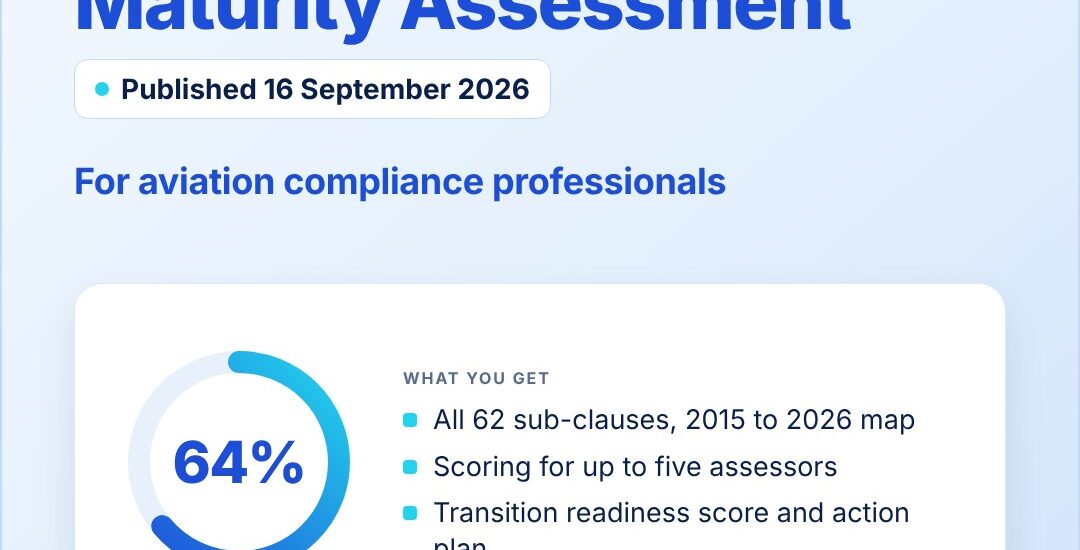
ISO 9001:2026 was published on 16 September 2026. What changed from 2015, what it means for aviation organisations, and a free maturity assessment tool.
A free SMS maturity assessment against ICAO Annex 19, 3rd Edition: 28 features scored from documented to effective by a team, with evidence checks.
A free process audit tool adapted from Hammer’s process and enterprise maturity model: score design, performers, owner, infrastructure and metrics.
What changes in IATA IGOM 15th edition and AHM 47th edition (2027): ramp safety, load control, SGHA, AHM 1110 training and what it means for ISAGO.
How Annex 19 Amendment 2 reaches ground handlers, fuel and de-icing providers from 26 November 2026, plus EU Regulation 2025/20 and what to prepare.
What Annex 19 Amendment 2 changes for aerodrome and heliport operators from 26 November 2026: interfaces, emergency planning and safety performance.
By Ferhan Bugay, Executive Director, Aero Support Group · 13 November 2026 · Updated 17 November 2026
From 26 November 2026, Annex 19, 3rd Edition (Amendment 2), is applicable to operators of certified aerodromes and, for the first time, to operators of certified heliports. An aerodrome SMS now needs a system description with interfaces, interface hazards in the hazard log, resources named in the SMS manual, safety performance measured against objectives, and emergency planning coordinated with the organisations that work on the airport. The authority will also assess the SMS periodically.
| Your organisation | Annex 19 or EASA basis | What it means |
|---|---|---|
| Operator of a certified aerodrome | 3.3.2.1 h); 4.2.9 | SMS acceptable to the State responsible for the certificate |
| Operator of a certified heliport | 3.3.2.1 h); 4.2.9 | Heliports are now named alongside aerodromes |
| Aerodrome or heliport that is not certified | 3.3.5.3 | Depends on national rules; the State should review whether to extend SMS requirements |
| EASA-certified aerodrome | ADR.OR.D.005 | A management system that includes an SMS is already required; Regulation (EU) 2025/21 amends it from 27 March 2028 |
The table takes the framework changes from the 3rd Edition and shows what each usually means for an aerodrome or heliport operator.
| Change and provision | What it means for an aerodrome |
|---|---|
| Resources join the first component App. 2, 1; 1.5.1 a) |
The SMS manual names the safety manager, the safety staff for airside, terminal and works, and the budget for reporting and analysis tools |
| System description, scope and interfaces 4.1.1 b)–c) |
A system description that covers the movement area, terminals, the fuel farm and works, and lists the organisations on the airport, with an owner for each interface |
| Interface hazards App. 2, 2.1.1 |
The hazard log covers airlines, ground handlers, fuel suppliers, ATS, rescue and firefighting, contractors and tenants, for example works next to active taxiways or vehicle traffic on the apron |
| Safety performance measurement App. 2, 3.1 |
SPIs such as runway incursions, FOD finds, wildlife strikes, apron incidents and airside driving infringements, with progress shown against each safety objective and evidence that key controls work |
| Emergency response coordination App. 2, 1.4 |
The aerodrome emergency plan is coordinated with the emergency plans of the organisations the aerodrome interfaces with |
| Objectives consider State objectives App. 2, 1.1.3 |
Safety objectives cross-checked against your State’s SSP objectives |
| Human performance 4.1.3 |
Investigation, risk assessment and change templates prompt for workload, shift patterns and airside signage and procedures |
| Effects from other domains App. 2, 2.2, Notes 1–2 |
Commercial and security decisions, such as a new terminal layout, a new airline or a change to screening, go through a safety risk assessment |
Periodic SMS assessment (3.4.1.3). Your State must assess your SMS periodically and monitor your safety performance. An assessor will want to see that the SMS runs: hazard log entries raised by airside staff and partners, SPI trends with action taken, safety committee minutes with decisions followed through, and investigations that changed a procedure.
Internal resolution policy (3.4.1.4). Your State must publish a policy on which safety events you may resolve inside your SMS. Check your occurrence handling procedure against it.
State-level SPIs (3.4.2.2). Where your State publishes safety performance indicators, it should ask service providers to consider them. Runway safety indicators are a likely place for questions.
| Area | Evidence |
|---|---|
| Resources | Safety manager appointment, safety staffing, tool licences |
| System description | Current document with facilities, organisations on the airport, interfaces and owners |
| Interface hazards | Hazard log entries for airlines, handlers, fuel, ATS, contractors and tenants, with risk owners |
| Safety performance | Twelve months of SPI trends, objectives with progress, one or more validated controls |
| Partner involvement | Local runway safety team and airside safety committee minutes with actions |
| Emergency planning | Emergency plan with records of coordination with partner organisations and joint exercises |
| Change management | Risk assessments for works, new facilities and new operators |
EASA-certified aerodromes already run a management system with an SMS under ADR.OR.D.005. Regulation (EU) 2025/21 amends the aerodrome rules, and the amended management system requirements apply from 27 March 2028. For these aerodromes the 3rd Edition changes are mostly about evidence: a system description with interfaces, interface hazards in the log, measured safety performance and coordinated emergency planning.
Annex 19 is not the only change on 26 November 2026. Amendment 18 to Annex 14, Volume I, and Amendment 10 to Annex 14, Volume II, bring their own dates for aerodromes and heliports.
| Applicable from | Change | Who it affects |
|---|---|---|
| 27 November 2025 | Volume I aerodrome design and visual aids: code 3 non-instrument runway strip width, threshold markings on all paved runways, runway distance remaining signs, closed runway lighting and markings, unserviceability signs. Apron management services must consider ground handling safety when aircraft move onto and off stands. | Aerodrome operators |
| 26 November 2026 | Volume II: certification and SMS for heliports intended for public use, with continuous State oversight. | Heliport operators |
| 26 November 2026 | Volume I: States must regularly assess the impact of ground handling operations on aviation safety. | States, and aerodrome operators that host ground handlers |
| 21 November 2030 | Volume I: new obstacle limitation surfaces. Obstacle free surfaces (OFS) and obstacle evaluation surfaces (OES) are sized by aeroplane design group, and an obstacle may penetrate an OES only if an aeronautical study shows no adverse effect on safety or significant effect on regularity. | Aerodrome operators, procedure designers, planning authorities |
For heliport operators, the Volume II change means the SMS now comes with certification and ongoing oversight, so the system description, hazard log and safety performance evidence in this guide apply to them as well. For aerodrome operators, the 2030 obstacle surfaces need preparation well before the date: obstacle data, safeguarding maps and an aeronautical study process. PANS-Aerodromes, Amendment 5, sets out how that study process should work.
ASG runs Annex 19 gap assessments for aerodromes and heliports with an evidence check for each element, and supports SMS implementation through ASG RADAR. See also our airport operations consulting and SMS development consulting. Write to info@aerosupport360.com.
Related: ICAO Annex 19 Amendment 2: the 11 changes · Annex 19, 3rd Edition, for airlines · SMS development consulting
The Amendment 2 differences checklist, a 28-feature SMS maturity assessment against the Appendix 2 framework, a dashboard and an action plan, in Excel. Versions for airlines and MROs, aerodromes and heliports, and other aviation organisations such as ground handlers, fuel suppliers and ATS providers. Fill in the form and the download links arrive by email.
Civil aviation authorities: this tool is built for service providers. For support with your State’s side of Amendment 2, tailored to the size of your State and the scope of your oversight, write to info@aerosupport360.com.
We use your details to send you the download link and to follow up on your request. If you tick the box above, we will also send you occasional ASG updates. We do not share them with third parties. See our Privacy Policy.
Yes. Operators of certified heliports are now named alongside certified aerodromes in 3.3.2.1 h) and 4.2.9. Uncertified heliports depend on national rules.
Every organisation whose work affects safety on the airport: airlines, ground handlers, fuel suppliers, air traffic services, rescue and firefighting, contractors and tenants. Each needs an owner in the system description (4.1.1 c)) and hazards in the log (App. 2, 2.1.1).
The aerodrome emergency plan has to be coordinated with the emergency plans of the organisations it interfaces with (App. 2, 1.4). Keep records of that coordination and of joint exercises.
Regulation (EU) 2025/21 amends ADR.OR.D.005, and the amended version applies from 27 March 2028. Your State can still assess your SMS against Annex 19 before then.
Partly. Amendment 10 to Annex 14, Volume II, brings certification and SMS for heliports intended for public use from 26 November 2026. Amendment 18 to Volume I applied its design and visual aid changes from 27 November 2025, adds the ground handling assessment from 26 November 2026, and introduces new obstacle limitation surfaces from 21 November 2030.
Weekly aviation safety and compliance intelligence covering ICAO, IATA, EASA, and UK CAA developments — translated into practical implications for airlines, MROs, airports, ground handlers, and aviation leaders.
Message us any time. We usually reply within a few hours.